
S2E10: Wearing (Down) the Body: Asceticism in Late Antique Monasticism
With Dr. Rebecca Krawiec
In our Season 2 finale, we learn about Christian women from late antiquity who sought to transform their bodies inside and out: ascetics and monastics. From fasting to renouncing sexual “appetites” to special clothing—there were lots of things that marked a monk. Dr. Rebecca Krawiec explains all of this and more.
Why did women join monasteries? What do we do with those extreme stories of saints punishing their bodies? How can letters give us a more full understanding of women monastics? Who were Tappole and her sister Tsophia?
“Our bodies are going to get ill. Our bodies are going to decay. Our bodies are going to break down. That’s the nature of the human body. And the question became, what does that mean if it can be made holy?”

BIO
Dr. Rebecca Krawiec is the Chair of Religious Studies and Theology at Canisius University. She received her undergraduate degree from Brown and her PhD in Religious Studies from Yale. Becky has received a Mellon grant and was a Research Associate in Harvard’s Women’s Studies in Religion Program. Her book, Shenoute and the Women of the White Monastery: Egyptian Monasticism in Late Antiquity, opens a rare window into women’s daily lives in a Coptic monastery. Her articles examine monastic living, gender, and Coptic Christianity. Becky’s current research explores the intersection of literacy and social memory in texts related to Egyptian monasticism. She is also a digital humanist; since 2013 she has been senior editor and translator with the Coptic SCRIPTORIUM project.
-
[podcast theme music plays]
Rebekah Haigh: Welcome to Women Who Went Before, a gynocentric quest into the ancient world. I’m Rebekah Haigh—
Emily Chesley: And I’m Emily Chesley—
Rebekah: Scholars, friends, and your hosts!
[music interlude]
Rebekah: In our last episode of Season 2, “Wearing (Down) the Body: Asceticism in Late Antique Monasticism,” we talk with Dr. Rebecca Krawiec about supernaturally long fasts, conflict resolution in a Coptic monastery, and the strange beings you can find in the wilderness.
[music interlude]
Emily: You never know what you might find in the desert. Christians in the sixth and seventh centuries told the story of a monk named Zosimus who trudged through the Palestinian wilderness east of the Jordan River.[1] After twenty days of walking, a strange body caught his eye. At first Zosimus thought he saw “a demonic phantom.” It was “a naked figure whose body was black, as if tanned by the scorching of the sun. It had on its head hair white as wool, and even this was sparse as it did not reach below the neck of its body” (Life of Mary of Egypt §10, trans. Kouli).[2] To the monk’s surprise, it was actually a holy woman known as Mary of Egypt. For seventeen years, Mary had lived in the desert, eating whatever herbs and sustenance she could find. Her clothes disintegrated, and she endured scorching afternoon sun without water and frigid desert nights without cover.
Rebekah: Why had Mary done all this? According to Mary, she fought against intense temptations, which she describes as “wild beasts.”[3] She longed for rich meat and wine, foods she had enjoyed in her previous life. Profane songs ran through her mind. She wrestled lust and desire for physical passions. The wilderness was her arena of repentance.[4]Mary admitted her survival had been a struggle, but said, “in only thinking of those evils from which [God] rescued me, I receive as inexhaustible food the hope of my salvation, for I feed and cover myself with the word of God Who governs the universe. For man shall not live by bread alone…” (Life of Mary of Egypt §30, trans. Kouli).[5] First written in Greek, her story circulated throughout late antiquity and became so popular that it was translated into a host of languages—among them Syriac, Armenian, Ethiopic, Arabic, and even Old English.[6]
Emily: If anything typified Christian holy women and men of late antiquity, it was that they went without. Luxury and marriage, but also food, sometimes shelter, clothing, and human contact. Some of the earliest Christian ascetics dwelt in the Egyptian desert in the fourth and fifth centuries, praying in solitude and fighting spiritual battles like Mary. Historians call them the Desert Fathers and Mothers. The words “ascetic” and “asceticism” come from the Greek work askesis, or “exercise.” These desert solitaries grew towards sainthood by exercising their bodies and souls.
Rebekah: In the late antique world, voluntary Christian ascetics weren’t the only ones with bodies bearing tell-tale signs of hunger, though. If the Nile flooded too little or too much, crops would be doomed, and the families that relied on them. High food prices sometimes led to riots.[7] When armies invaded Judea or locusts swarmed Mesopotamia, the food shortages forced people to beg on the streets, flee to new towns, and even surrender their children—if they survived.[8]The effects of famine could even ripple across the sea. If North Africa or Egypt had no grain to export, Roman markets wouldn’t get their deliveries.[9]
Emily: Large-scale disasters intensified hunger, but food insecurity never truly went away. Scholar of ancient Mesopotamia Seth Richardson defines hunger as “the routine and everyday subnutrition which was less than famine, but more than a temporary inconvenience.”[10] From the ancient Mesopotamians to the Romans, large swaths of society lived on the brink of starvation. Mostly those who were poor. In fact, Richardson talks about the semantic range of words related to hunger in ancient Babylonian. Some words described the physical feelings of hunger and others the limited access to food, while “A third and smaller set of words used hunger as indexical to poverty, such as erû, ‘empty-handed,’ and ekūtu, ‘homeless girl’.”[11] People knew, to be poor was to be hungry. When Jesus instructed his followers to pray, “Give us this day our daily bread,” he wasn’t only talking in metaphor (Mt. 6:11).
Rebekah: Hunger may have impacted certain social groups more than others, like children and women.[12] The Roman poet Ovid, in his famous Metamorphoses, personifies hunger as a woman “plucking… at… scanty herbage” in a stony field (Ovid, Metamorphoses 8. 799–800, trans. Miller).[13] “[H]er eyes were sunken, her face ghastly pale; her lips were wan and foul, her throat rough with [flaking skin]; her skin was hard and dry so that the entrails could be seen through it; her skinny hip-bones bulged out beneath her hollow loins” (Ovid, Metamorphoses 8. 801–804, trans. Miller). Ovid’s choice to symbolize hunger as a woman [is] striking, and perhaps not accidental. Certain Romans provided food support for local children, but evidence suggests that girls received smaller donations and over shorter periods of time.[14] One first-century CE inscription from Veleia, Italy, documents that imperial and private donations supported 300 children, 264 of whom were boys (CIL XI 1147).[15] Girls were also more likely to face infanticide. Scholar Christian Laes comments that when all such factors are paired with women’s early marriage, frequent childbirth, and physical labor, the ancient stereotype that women were the weaker sex “became self fulfilling.”[16]
Emily: What’s especially startling about the Christian ascetic movement, says historian Gillian Clark, is that women took part in it. Early Christianity belonged to a Greco-Roman cultural landscape in which women were understood as physically and morally weaker than men, more susceptible to the desires of the body and less able to overcome their own physical needs.[17] But with the rise of Christianity, the so-called “weaker sex” wasn’t about to be left behind. Fasting was for all women, not just nuns. The perpetually disgruntled Jerome believed that prior to the Virgin Mary women were more susceptible to lust than men, and by depriving themselves of food they could develop control over their sexual appetites (Jerome, Ep. 22.21).[18] “Not that the Creator and Lord of all takes pleasure in a rumbling and empty stomach, or in fevered lungs; but … these are indispensable as means to the preservation of chastity” (Jerome, Ep. 22.11, trans. Fremantle).[19] Like their fathers, brothers, and sons, many late antique women willingly chose hunger as a path to holiness.
Rebekah: One place where you could challenge your spiritual grit was the legendary White Monastery. Founded by a monk named Pgol in the fourth century CE, the White Monastery lies along the banks of the Nile in Upper Egypt [near] modern-day Sohag. It was part of a federation of men’s and women’s monasteries, and its most famous abbot was Pgol’s nephew, [the] charismatic Shenoute of Atripe.[20] Shenoute (c. 348–465 CE) is one of the most well-known saints of the Coptic Orthodox Church, and he wrote many sermons, letters, and monastic canons in Coptic, an indigenous language of Egypt. The White Monastery and its federation was a successor of sorts to a different Egyptian federation: Pachomian monasticism. A generation or so earlier, a soldier-turned-monk named Pachomius had composed the first known rules for Christian monastic life for his own followers.[21] Caroline T. Schroeder has explained it: in Shenoute’s worldview, a monk’s salvation was directly tied to the whole monastery’s salvation, and every person’s purity or sin contributed to the whole. “The purity of the corporate body depends on the purity of the individual monastic body.”[22]
Emily: The literary genre of saints’ lives (which scholars call hagiography) gives an important perspective into how late antique Christians idolized great ascetics. Mary of Egypt’s Vita (or Life) was told as a hero’s journey. It was polished, heightened, and shared in churches Mediterranean-wide. But letters written by Abbot Shenoute to women in his federation offer a much less varnished view of female ascetics than those hagiographies. In the letters, we find infighting and complaining, arguments over clothing, and sexual tensions.
Rebekah: We see in Shenoute’s letters that the women weren’t always the obedient monastic followers that you might find in pious discourses like the hagiographies. In fact, they could get pretty opinionated. Once when Shenoute had gone to the women’s compound to intervene, he ripped his clothes in a biblical performance of frustration. Presumably he expected them to quickly repent. Instead, one woman responds hotly, “What’s wrong with you, that you tear your garments?” (XC 219: i.12–16).[23] She chastised him right back. You can still visit the archeological remains of their communities. The Red Monastery’s church is even covered with its original paintings.[24]
Emily: We’ll come back to the women of the White Monastery and to those legendary saints. But first, let’s meet our guest: Dr. Rebecca Krawiec is the Chair of Religious Studies and Theology at Canisius University. She received her undergraduate degree from Brown University and her PhD in Religious Studies from Yale. Becky has received a Mellon grant and was a Research Associate in Harvard’s Women’s Studies in Religion Program. Her book, Shenoute and the Women of the White Monastery: Egyptian Monasticism in Late Antiquity, opens a special window into women’s daily lives in a Coptic monastery. She has also written a number of articles, including on monastic living, gender, and Coptic Christianity. Becky’s current research explores the intersection of literacy and social memory in texts related to Egyptian monasticism. She is also a digital humanist; since 2013 she has been senior editor and translator with the Coptic SCRIPTORIUM project. We are so excited to welcome our last guest of Season 2!
[music interlude]
Rebekah: With the rise of Christianity in late antiquity emerged a new trend: asceticism and monasticism. Renouncing ties to family, practicing self control in the form of fasting, giving up sex, and pursuing piety. How were saints and their embodied lives supposed to be different from the normal person’s? And what was the goal of asceticism?
Dr. Rebecca (Becky) Krawiec: I mean, it's the $64,000 question, right? [laughs] What was the goal of asceticism. And ultimately, the goal of asceticism is to transform the body. And it was an idea of being able to get these saints’ bodies in between a state of a normal body and the resurrected body. So one of our monastic writers from late antiquity said, “ascetic bodies are proof of the resurrection.’ So there, nobody knew what the resurrected body was going to be like. Nobody knew what angels look like. But there was this idea that the asceticism—askesis is the word in Greek, and it just means “training” —like these bodies could be trained in order to control the desires, control other aspects in order to let the inner self develop.
And asceticism wasn’t unique to Christianity, not unique to late antique Christianity. A lot of people who study asceticism are very interested in sort of cross-cultural studies of asceticism. So my answer is very much located in late antique Christianity, right. There might be other goals of other forms of asceticisms right.
But there was this idea, you know, that the body had these “wild parts,” as one person said. You know, asceticism is going to “soothe the irascible aspects” of life in order to be able to develop this other part. And a lot of those desires in the theological language of late antiquity were tied to demon attacks, attacks by the devil.
At the same time, you know it's a huge paradox, because the human body was also part of God's creation, right. And that was supposed to be good, but somehow it's gone bad. [laughs]
And so one of the reasons that I find studying asceticism so fascinating is there's so many paradoxes involved in it. They're trying to transform the body even as you recognize the limits of your ability to do so. You're trying to say they're things about the body that you're trying to control, often presented in negative language, but you also don't want to say these things are bad. So when they're bad, they're from the demons, right. [chuckles]
And so you have a lot of different aspects of trying to figure out what it meant to be human in this particular cultural moment, this particular cultural setting of—especially in the fourth century—a changing, Christianized world, right.
So we certainly see asceticism or ascetic tendencies, I guess earlier than fourth-century Christian writings ,and there's not one position for asceticism in even in the fourth century. Asceticism is in almost every aspect of Christian writings.
Emily: I love this phrase, “the wild body.” Could you say a little bit more about— If we have saints who are (or people) pursuing askesis—was there a sense that the people who weren't doing this were lesser? Or, you know, are people living in their houses and fasting four days a week, and so maybe there isn't a differentiation between ascetics and “normal people,” as we put the question?
Becky: The question I would say that yes to all of that, yes, people practice fasting as part of, say, the liturgical calendar. Yes, we have evidence that there were women who were taking on, let's call them, lives of renunciation within their household. So there was not just one way to live as an ascetic.
And of course the hagiographies we have all tend to be hero stories, right? They all tend to be magnified. And one of the reasons I love studying the White Monastery was because the sources were not hagiographical. And it just, it made things sort of more alive to me in a way.
But there was a lot of concern about the body for normal people too, within Christianity and outside of Christianity. Some of the fasting practices that we see are linked to medicine, part of health regimens. And so I think that for a lot of people, fasting or intake of food was really dependent on what was available.
One thing especially when we see descriptions of more extreme fasting that certainly come out in the hagiographies, one thing that we have to keep in mind is that there was an incredible amount of food precarity in the ancient world. I mean, I think a lot of people were on the verge of starvation most of the time. And so in that context, what does it mean that somebody embraces something that might have been really scary and difficult in the larger cultural context?
Emily: I think no one had really pointed out clearly to me that we need to think about, you know, asceticism and fasting in the context of the extreme poverty, and food poverty specifically, in this world. And that there's something beautiful in a way about a community choosing to make holy something that might have been forced upon you anyway. It almost reminds me of, was it Viktor Frankl, who writes about in the Jewish communities in the concentration camps where the only thing you could control is how you respond to the situation. And there's something about, you can't control that you have no food, but there is a way of being able to find agency or make something meaningful or holy about that situation.
Becky: One of the things that seems to be the case in the institutionalized situations of communal monasticism was that now you had a secure source of food, right? Because the monastery would grow its food, and it would bake bread, and it would provide its food. And you weren't living a life of luxury, but you know—and you were going to have to undergo fasting, possibly on a, you know, a higher level, especially during Lent and stuff like that—but you had food.
And so we have a lot of evidence in the White Monastery that monks are stealing food, [laughs] and that monks are hoarding food because they want to give a little bit extra to one of their friends. And so food absolutely was something that was monitored. And there were rules about people who were sick in the infirmary in the monastery would have different access to food than your regular monks. So you had to make sure nobody was faking illness into the infirmary to have that!
Emily: Hagiographers celebrated how extreme fasting transformed the bodies of women into something alien. We read about the monk Pelagia, whose life of severe fasting so transformed her body that she went from a famous, recognizable beauty to being mistaken for a eunuch: her body withered, her eyes sunk into her skull (Life of Pelagia 14).[25] Similarly, Susan reportedly lived in the Egyptian desert for three years eating only a dried hunk of bread each day and receiving a pitcher of water on Sundays (John of Ephesus, Lives of the Eastern Saints 27).
These extreme accounts can be jarring and uncomfortable to modern readers. First, what was it about fasting that made it a path to transcendence? (You’ve kind of already touched on this). And what does appetite have to do with sexuality and the female body in particular?
Becky: The answer lies in appetite, right, [laughs] that both food and sex are bodily appetites. We don't talk about having an “appetite” for clothing. Even sleep (because sleep deprivation is also one of the ascetic practices); you know, we don't talk about that in the same language.
Whereas the ancient sources pretty much are saying, you're going to have to fast in order to be able to have the sexual renunciation. That is for multiple reasons. And so I'm going to actually have some male examples, and then I'll get to the women. [laughs]
Again, it has to do with the transformation of the body, to see the inner self, and to the extent that the inner self was not linked to the flesh, right? So it's not linked to markers of gender. But something's going to happen to the body to make it different, because that difference is what is the source of holiness, right?
So women in the examples you read lose their breasts. We have to assume that they stop menstruating. Nobody's like, “And then she stopped bleeding,” right. Like there's this big gap. Clearly, though, they had to have been. And so that is something that I want to think more about, actually, moving forward. And if it's not talked about in the sources, why is that missing?
There's an example from a man who's writing in Syria (his name is Theodoret), where he talks about a male monk who has fasted to such an extreme that his butt and hips had been worn away and provided “an easy downward passage for the belt.” And “belt” here is going to be a very important word when we get to clothing, because there's this belt that marks monastic identity. So this guy's body has been transformed so much that it cannot wear the thing that says “I'm a monk” because the body itself is sort of doing that at that point. So almost every time that you have a description of some sort of massive change to a body like that, it's saying something about how that physical transformation is linked to an innertransformation.
But in terms of the female body. (Oh, this is a good answer for the whole “normal person” thing. [laughs]) The same person, Theodoret, who's writing in Syria, tells a story about his mother. And his mother had gone to a holy person because she needed to be healed in some way. She was refusing food that the doctors had said were appropriate for her condition. And so she goes to the holy man. The holy man is like, “well, you need to eat” right? [laughs] “And it's okay. Like we know that you're trying to practice asceticism." (And this is Theodoret’s mother. She's not practicing sexual renunciation!) She's married, but she was trying within the context of her life to embrace a sort of ascetic tendency through her fasting. And she had apparently, was ill. And the holy person said, “You need to eat, and it's okay for you to eat right now because you're doing it out of need, and not out of, you know, gluttony or desire.” So I like that. I always like the story about the non-ascetics and asceticism, because you have a story there where somebody was trying to follow these religious and social pressures. How do we be holy, and what is that going to look like? And then had the holy person saying “no, no, it's okay.” That is one of my favorite stories.
But we also of course have the extreme fasting. You have Mary of Egypt, who goes out into the desert and she leaves with two loaves of bread. And Zosimus finds her years later, and she hasn't had anything more than two loaves of bread, and her clothes have worn away, and her body's blackened by the sun, and he has no clue. Like he’s worried that actually she might be a demon. And you know then she says, “you know, you need not look at me because I'm a woman,” right? This is what I mean by the paradoxes and the tensions. And did people take these seriously, but not literally when they heard stories like this? I think probably to a certain extent, yeah.
But it does get back to that sort of first question of what's the goal of asceticism. And because part of the goal of asceticism is to fix a self that's sort of a countercultural self.
And I do agree that the extreme fasting can sound jarring to modern ears. In the late twentieth century, there was a book called Holy Anorexia, and I was like, no. [laughs] Yeah, let's not do that, right. (I mean, it’s a great book.)
On the one hand, we have to read the sources within their context—within what they're trying to argue and what they're trying to say. But their context is theological. And so you do run the risk of, as one scholar put it, “over-theologizing the body,” because they're sort of over theologizing the body and missing some of the harm that can be done, right? And that's why you have to go back to that tension, right, like you're allowed to control the body. But where's the line between controlling the body and harming the body? Which again, is God's creation. (Which also theologizes the body.)
Life of Syncletica is probably one of the most famous examples of this. Because like most of the women, she starts off as a great beauty. [laughs] Right, so was Mary of Egypt, by the way, great beauty. They're all starting off as great beauties. And their great beauty is either a source of sexual desire for others or a source of their own sexual desire. Mary of Egypt very famously, was very sexually promiscuous and she's like, “and it wasn't even for money.” [laughs] So her transformation in the desert took on this other layer. Syncletica also a great beauty, also engages in more extreme fasting, though she also, you know, urges moderation for others. A lot of our more extreme saints do take that position of, you know, if you can't do it, that's okay.
And Syncletica, her hagiographer details her final illness that destroys her body bit by bit. And it is, again, presented in theological terms. That the devil has not been able to defeat her in her years of asceticism. She—even though she remembers how much she loved, you know, wine and good food and lewd songs and other things like that—she's maintained that askesis. She's maintained that training. She's maintained that self-control. And so in the end her body falls apart bit by bit. Attacking organs, having her teeth fall out, her gums decay, that goes into her jaw. It is detailed, But that's what happens to bodies, right?
I mean, part of it is—and per your your earlier point—our bodies are going to get ill. Our bodies are going to decay. Our bodies are going to breakdown. That's the nature of the human body. And the question became what does that mean if it can be made holy? And then it's less, perhaps it's less scary. I'm sort of making that up. But perhaps it's less scary.
Rebekah: I guess when I always thought about asceticism, I always think about it in terms of like my context—right, first century, with the Qumran community, right? And there was a suspicion about the body. And so the goal is to sort of get a better body, you know, and it would be more like the angels, who presumably don't have these ills, right? Their bodies aren't falling apart; they don't need to eat; they don't age there. Is that similar to the dynamic that's going on here, and what does that reflect about this time period and the way that people are looking at the flesh, right? Is the body bad, or is the body something that we just deal with?
Becky: I would say that how you described Qumran would be very similar to how I would describe thinking about the body. It's, you know, I'm going to use the title of a book on fasting and sexuality in late antiquity, The Burden of the Flesh.It's not bad. It’s a burden, something you have to carry with you, a weight. And it hurts, right. [laughs] It does all these things. If we can imagine an existence that didn't have the need to eat, the need to sleep, the need-slash-desire to have sex. Can we imagine a life without these burdens, without these sources of pain?
And yet at the same time even as I say that, central to asceticism is an idea of suffering. And so you're going to work toward— You right now in your ascetic life are not gonna be in the pain-free perfect body of the Resurrection or the angelic life. You are going to be in a suffering body, right. And obviously, I mean, cause suffering Jesus does [laughs]. And you know, that was, the idea of suffering as the sort of central aspect leading to salvation was basic, right? I mean, that's Christianity 101. And so there was a way of saying yes, we need to embrace the suffering—which does sound jarring because, of course, suffering is going to be like physical suffering, because it's suffering in the body. The body is the burden, but it's a burden you're embracing in order to do this other salvific work.
The ascetic body is one that is, yes it's being transformed in a way that's in accord with cultural values. And yes, the ones in the hagiography are the extreme examples of that. It's not that there's going to be this moment that everyone's gonna be like, yes, you have it! Right, because perfection and humanity are incompatible. And so even as the hagiographers are going to say, “oh, this person was so perfect in all of God's works,” the saints themselves never say it. And they're like, “ohh, no, I still struggle with the demon of passion until, you know, the moment of my death,” right. You know, whatever their particular burden is, they continue to struggle with that.
So it is a preview. The ascetics suffer in this life, in this body. But in so doing they can transform that body in such a way that you can say, we can imagine an existence beyond this body.
Rebekah: Sort of pivoting from that because sort of, there’s the transformation of the body that we can’t ever achieve. But there is a sense in which some of these transformations do have real-world effects.
Becky: Mhm.
Rebekah: So famously, one of the draws of the monastic life for women in late antiquity was the option to avoid marriage and motherhood, and take a life outside of the social norms and power dynamics. But your research suggests it might have played out less than ideally in practice. So you study the community of the White Monastery. So did becoming female monastics allow these women to escape their gender with all its social hangups and limitations?
Becky: Not all of them.[laughs] Some of them.
So I'm going to focus on the White Monastery in this question. The evidence we have for the White Monastery is not hagiographical. So you're not going to see stories about these beautiful women saying no to all her suitors. And you're not gonna see women telling their husbands on their wedding night, “I've decided we will be having a celibate marriage,” and then the husband sort of saying, “No, we really need to have the kids.” Like, especially if they're of a certain class. (I'm thinking of Melania the Younger here.)
In the White Monastery, we don't really know why people were joining the monastery. We only have the letters that are describing to us the rules, the regulations and some of the situations within the monastery.
And we know that families joined the monastery en masse, right? So these are not people who are, you know, bypassing marriage and motherhood, right. But for whatever reason, those husbands and children are coming with them. (Or maybe it's the other way around.)
Then within the monastic life in the monastery we have what I apparently referred to in the year 2002 as a “universal monasticism.” [laughs] That is to say, Shenoute, the third head of the monastery, Shenoute says over and over and over again, “This is the expectation whether male or female.” And to me, it's always been important that he says “whether” male or female. He does not say “neither.” He's saying, whether you're male or you're female, you are all going to follow this rule. And if you break this rule, cursed are you, whether you're male or you're female.
You know Shenoute had this absolute idea that there were practices and expectations of asceticism and ways of living that everyone was going to follow. He had an emphasis more on some sort of inner nature that could attain that way of life. And so we don't have like a denial of gender. We have an idea that—and I think this does, you know, he's not saying, “Oh you women over there who are weaker, you don't have to do that,” right. In one of the descriptions of one of the Pachomian monasteries there was a rule for the men. And then Pachomius had to create a community for women for his sister, and then they were given the same rule but they didn't have to wear this one piece of clothing. And it doesn't say they couldn't wear it. It says they didn’t have to wear it. And so when we turn to the White Monastery, we're seeing, you know a similar idea: there's going to be a rule for the people who live there.
At the same time the women do live in a separate community. A physically separate community, which has been located through archaeology. They lived in a separate community. And so there were rules about contact between the community—especially between family members. Right, were women allowed to just go to the men's community because they missed their son? No! (And yet many of them wanted to.)
And so you have a lot of tension around gender in this community because the expectation was that you'd given up sex. (Though many of the women were having sex. [inaudible]) But you were supposed to give up family ties. And those bonds are one of the biggest markers of gender in the White Monastery, and the extent to which they remain in place in a way that Shenoute was not in agreement with at all.
This also makes me think of your earlier question about “was there a hierarchy.” And one of the letters Shenoute writes seems very specifically to say, there should not be a hierarchy. There seem to be an indication that some people in the monastery were like, “Well we came into the monastery never having gotten married. So we are the true virgins and eunuchs for God. And these other people, you know…” And Shenoute was like, “Well, they actually have to live next to their family members as if they're not family members. So that's in some ways even harder. So I think we're all virgins and eunuchs for God.”
So this question of spiritual status and spiritual hierarchy was a really important one. And we do have examples of people in the fourth century saying, we need to be really careful with this embrace of asceticism that there isn't this idea that some people are spiritually superior to other people.
Emily: When I first read your book, this was the thing that was most mind-blowing and impressive to me is. The language is, you know, women left their families and fathers; and entering a monastery was a way to escape the framework of the pater familias. But then to discover that entering the monastery just reinscribed those same dynamics with different people.[26]
Becky: [laughs, lines overlap] Boy, they just stepped into a totally different pater familias, didn’t they? And Shenoute
Emily: [lines overlap] Yes. And with some extra spiritual, like you know, gatekeeping around that.
Becky: A lot of spiritual gatekeeping.
I think, when I think about— Sure in Shenoute it isn't true. In the letters of his successor Besa, the thing the women seem to have been most resistant towards was getting beaten. We have the list of women who are supposed to be beaten in one of Shenoute’s letters. We have a woman in one of Besa’s letters who's threatening to leave the monastery because she does not want to accept her punishment, and Besa’s like “you will lose your profit” (he means salvation), if you know you don't accept this punishment.
This one name appears. It's a female name, Tapolle. Appears several times in Shenoute’s letters, so that you know, I've been left with the impression that this is one person. If it is all the same person, we have like this little biography of her. She had a sister, Tsophia. They're both listed as people who are going to get beaten. Shenoute was not always clear [why]. He's, “I know why I am assigning this punishment. I'm not going to tell you, but I know why.” Right. And so they were somehow both involved in some sort of disturbance. And, you know, Shenoute likes to talk in metaphor all the time, and the so he uses a clothing metaphor to talk about this disturbance. And yet at the same time, like elsewhere Tapolle appears because she is involved in clothing production in the monastery. And then she appears another time because she and the female head of the female community are having a big fight, and Shenoute’s trying to like smooth things over, and they're just, they're going at it. And so then finally one of them apologizes, and the other one goes, “I don't care. I'm not accepting your apology.” And so then it was like, “Well, I at least apologized.” And it just goes on. And you're just like… You read these things and you can imagine it. You can imagine this woman saying, “Psh! I don't like her.” And that's not a hagiography!
And then, of course, we have very similar things in Besa. One woman's reaching out to her parents who are outside the monastery going, “I hate it here. [laughs] They're so mean to me.” Besa’s like, “You can't say you hate it here, because you got in trouble because you gave perfume to that younger woman.” (How could they get perfume? [laughs]) So I do enjoy reading about these women who are living monastic lives.
Gender is a very important part of the institution of the monastery. It's a very important part of how everything’s constructed. But when we read about them, we're not reading about a female saint being constructed through a male lens for particular purposes.
Emily: So throughout history, clothing has been a way for people to express their identity and community affiliation, and sort of signaling some ways of behavior. Like you recognize a sports fan by their jerseys. In his letters, Shenoute sees monastic clothing as dressing like an angel and a priest in garments of salvation.[27] Can you tell us a bit about what monks wore? And what did these outward displays of dress signify about the women who wore them?
Becky: They wore a habit. And it was so understood what that was, is that it’s not explained to us. And so even in the History of the Monks of Egypt, this one monk is credited with inventing the habit. And that's all that it says: “And he invented the habit.” So I can't tell you what it looked like.
But I can tell you that it was absolutely the marker monastic identity, right? So in the Sayings, monks will say to each other, “So how long have you been wearing the habit? When did you put on the habit?” So yes, it's absolutely, clothing is a marker of identity, and that is abundantly clear in monasticism. And when John Cassian starts writing about Egyptian monasticism that he has experienced, he has a whole section saying, “here are all the different items of clothing. The habit, the mantle, the staff.”
And so we know it's drab. And we know that it's supposed to be this sort of shared marker. And we also know that it was socially disruptive, right? So if monks came into the city, they're not going to be in keeping with sort of usual clothing norms. And they seem not to have bathed for quite some time. That's my sort of short answer to what did monks wear.
But what did they signify about women in particularly, is going to really much depend on the woman. I'm going to use two examples. My one example is Melania the Younger. When Melania the younger embraces a life of asceticism, having gotten married and tried to have children, and finally moved past that, her progression in asceticism is absolutely marked by clothing, right. So she goes from being able to wear a head covering, to wearing a specific garment, to wearing a specific hood. She's willing to wear these social markers of clothing when she meets the empress so that she's not switching back to what she should be wearing to mark her particular social status within the Roman world.
And although she doesn't wear this sheepskin mantle (this same thing that the women in the Pachomian monasteries are like “No, no, no, no, no”) she does get given a belt, right? And so in Latin– but the word for belt here is the same word that [John] Cassian uses in his description of different monastic clothing that says “it's the belt that makes the holy man,” right. And now indeed, Melania is walking around with this belt. She's also able to use that belt to perform miracles. And so you have this idea that she is using this male clothing as a male monk might use this clothing. And that this shows her progression.
And after her death, Melania is buried in layers of clothing. Clothing that were gifts from various different holy people. So she had the tunic from one saint, and she had the same belt which she had worn when she was alive, she has a hood from another saint. So she sort of co-ops all the holiness of all these figures in these layers of clothing that she is being buried in. It shows her status.
In the White Monastery, this same word for belt also appears in some of Shenoute's writings. It's been sort of brought into Coptic. We have another word for belt that's a word of Egyptian origin. But we see this other word — the eight times that it appears, it's often appears alongside another loanword into Coptic that a scholar named Anne Boud'hors has recently argued, “I think that's the female belt.” So I'm not 100% sure about this; this is something I'm working on at the moment. But I think it might be possible that in the White Monastery they had the same tunic, but then they might have had different belts. And I don't know exactly what would have made them different, but there are definitely two different terms that are getting linked together.
And so what women's monastic clothing does is it shows that they have stepped outside certain social roles. To the extent that they start to transform their gender, it's not just that they're going to be disguising themselves. Pelagia disguisesherself in male clothing to pass herself off as a man in a male monastery. Melania the Younger is not disguising herself as male; she's taking on male authority.
Rebekah: So you’ve written about how late antique authors viewed monastics (women included) like angels, as a special holy group of people.[28] But we’ve been thinking about their simultaneous separation of female monastics from monks. So, women monastics still seem to retain a danger for men—women were strictly off-limits in male monasteries. And so there’s a reason why Abbot Shenoute are writing all these letters about these [laughs] troublesome female monastics rather than having these arguments in person. And when they do, or when Shenoute visits them, scandal and controversy erupt. Major controversy. Very amusing controversy, actually. So did late antique writers ever think about this ironic juxtaposition: that women monastics are holy and like the angels because they’re pursuing the monastic life, and yet, they’re still dangerous and sinful because they’re women.
Becky: One of my favorite phrases from scholarship on women in late antiquity is from Patricia Cox Miller, where she says that “holy woman” was a paradox in antiquity. And right obviously, cause if you’re holy, you're not gonna be a woman. If you're a woman, you're going to be sinful. You're not going to be holy.
And so because it's a paradox, how is this going to be managed? There are rules about contact between the male and the female communities in the White Monastery, including even for funerals. Did that have to do with concerns about, like illicit sex? Or did that have to do with concerns about eradicating previous familial bonds? Did it have to do with both?
Obviously I think it has to do with both, right. That there was this very heterosexually-focused. this idea that these communities needed to be kept separate. I think in the Pachomian literature, it's like, you know, in order to be the overseer for the female community, a man had to be of certain age. And it's very much implied 60 or above, right. [laughs] Something in which maybe this isn't going to be so much of an issue.
And beyond the White Monastery, it absolutely comes up in other monasteries (what are referred to as “double monasteries,” male-female monasteries) elsewhere, right. And in one of them, the male monk who is the head of the group of women is described as having been able to rid himself of masculine desires. That is to say, heterosexual desire for the women who he is overseeing. And he is simultaneously, and I'm quoting here, “bridled the feminine traits of the women.” Which seems to be that they’re a source of sexual temptation. So he's controlled himself. He's bridled them. And “thus,” says our source, “scriptures have been fulfilled and there's neither male nor female.” Because once the sexuality (heterosexuality) was eradicated, that it was what was achievable. That's a more hagiographical source. That's an ideal.
We have evidence in Shenoute's writings that there were men in the monastery who made themselves eunuchs for the kingdom of heaven, and Shenoute’s like “Out. No.” So yes there's this concern. The regulations about it are absolutely about contact. When I think about like all the examples, right—a woman who puts herself in a tomb with, like, just a little slit for food to go in and out so no one can look at her because one time a guy looked at her and fell in love with her and she caused him sinful thoughts. And so now she's going to hire herself away forever and ever and ever. We have those stories.
But one of the things that I think is the most dangerous, when men got the most worried about women, was when they acted on their own. And so Shenoute’s most concerned about these women when they say, “We're in our own community. We can make our own decisions.” And he’s sending the letters, but he is sending the letters through a male elder. So even as the overseers are never supposed to speak to the female elder one-on-one, there are these gatherings where these letters are read to the women as a group, and men are present for that. That's part of the power structure. That's acceptable. But you don't want to have any secret meetings.
And you don't want to have, the men are out in the fields and the women are, you know, taking a walk; you don't want them running into each other. Though, this is making me think of one particular passage in a piece of monastic literature where some women monastics are walking down a road. And some men monastics are passing them, and one of the men says to the woman, “You really shouldn't be out here.” And she says, “Yeah? If you were a real monk, you wouldn't have even have noticed we were women.” [Emily laughs] It's like, take back the roads for the female monastics, right? Like, “this is our space too. This is not our fault. That you have to sort of monitor yourselves rather than asking us.”
And you know, you see this in some of the sayings of, you know, one of the Desert Mothers where some guys show up to Amma Sarah, and they're like, “oh, we want to humiliate this ‘old woman,’” which of course is a term for an older monk. And then they say, “who do you think you are, you woman, doing this?” And she goes, “well according to my body I'm a woman, but not according to my thoughts.” Obviously for Amma Sarah being a woman's not a great thing, cause she’s moving past it. But you definitely have this idea that women are going to be part of this movement. That's gonna to have to be worked out in a way that recognizes the holiness of the women as well.
And I also think of this one woman that Augustine writes to—and this gets back to clothing—she and her husband have entered a celibate marriage. And then she gives up the dress of a married Roman matron, and she starts wearing widow's clothes. Her husband’s still alive. And he's like, “No!” And she's like, “No, because this is part of my asceticism.” And Augustine writes to her. He says, and I will quote Augustine here, “What is more absurd than a wife lords it over her husband about a lowly garment when she could have been more useful to obey him with shining deeds.” The idea here that she's made a decision for herself is what makes her dangerous. Women are dangerous in a patriarchal world, right. [laughs] And so even when you have a woman like this woman who has “bridled” her sexuality, and is wearing the markers of a nonsexual being, a widow, that was not okay because she didn’t have permission.
I think asceticism and monasticism gave options and provided new ways of living for women, and in ways that were [sighs] jarring and socially disruptive. And we see echoes of that in our male-authored sources.
Emily: I feel like both possibility and power, and also dangers and threats have come into this conversation a lot.
Becky: Yeah.
Emily: And it makes me think about today. You know, while the motivations are different, bodily restrictions aren’t uncommon. Girls and women sometimes go through extremes, like starvation, even surgery, in order to achieve a culturally—and I use this in many, the largest scare quotes—“perfect” body and the rewards that it claims to offer, like fame, wealth, cultural capital. I wonder if we can reflect a bit on what are the powers and dangers to bodily self-control? Ones that you see in your sources, and maybe ones that we could take something from today?
Becky: So there's always power and agency to the extent that women then or today are choosing for themselves, “This is who I want to be, and this is how I want to present myself.”
But all our desires are always culturally constructed. The idea that we have sort of total agency is in some ways a fiction. Because what we want to choose and how we see ourselves is in constant conversation with the world around us.
So I would say the main danger I see in the ancient sources, is that there's something wrong with being female. And that women wanted not to be female. (If they did. I don't know if they did, but they're presented to us as sometimes not wanting to be female, or not wanting the things that in society came from being female.) But again, in an ancient world where lots of women died in childbirth, maybe you don't want to be pregnant, you know. Maybe that's a way of living a longer, healthier life in some ways.
So I think power is available to ancient women in this transformation to the extent that they could say (I'm going to be very spiritual for a second), “You know, this is how I want to live in a way that connects me with God. And this is, you know, this is what I'm doing within this faith construct to achieve salvation.” As I say, when I look at the women joining the White Monastery, I have no idea if that's what was actually driving them. But to the extent that it was an option in the White Monastery space—like that physical space gave them their own power over themselves. And even as they found themselves in a patriarchal structure, in a regular household you wouldn’t have these two different spaces. And I think it provided a lot of opportunities for them.
As I said earlier, when I think about women today being presented with perfect, idealized bodies and the things one goes through for that, the danger is that there is such a thing called perfection. And I would say my ancient sources are actually pretty careful about that [laughs], right. Like that's going to be in the next life, right? That's not going to be achievable in this life, you know. And so instead you have these transformations of the body to try to imagine a perfect life elsewhere. The idea that you could achieve that perfection here, I see as somewhat different.
So the goal of asceticism in antiquity was not to have a perfect body. It was to have a transformed body that looked ahead to a perfection of a different life, an afterlife, a resurrected life, an angelic life. Whereas I think in modernity, there's this idea that we can achieve perfection in this body, and I don't think an ancient person would have argued that at all.
[music interlude]
Emily: As we’ve talked about the extreme asceticism of some of these late antique women, you may have noticed some unsettling resonances to our modern world. More and more young people are seeking care for disordered eating, a trend that seems to have been exacerbated by the Covid pandemic.[29] A 2023 study found that 1 in 5 teenagers across the globe suffer from disordered eating, girls especially.[30] When the world goes wrong, one thing you can control is what you consume. An increasing number of scholars have studied medieval religious fasting in light of modern science on anorexia. Gail Corrington has suggested that modern and medieval forms of food denial enable women to exert control over their environments, exercise power over their bodies, and in their askesis experience self-liberation.[31] As she puts it, “Eating and noneating thus become symbols of power and control: refusal to eat is a refusal of any authority over the body other than one's own.”[32] The famous twentieth-century French mystic Simone Weil also understood eating as tied to sex and power. By refraining from it, she simultaneously rejected power so she could be united to the divine.[33]
Rebekah: Simone’s perspective is an important reminder that for these Christian mystics, fasting was also a religious experience. According to historian Carolyn Walker Bynum, for western [European] medieval women, fasting was about more than controlling self and surroundings, it was also about mystically uniting them with God.[34] By rejecting human food and receiving the Eucharist, these women entered into the sufferings of Christ on the cross, “a kind of audacious deification.”[35] Catherine of Siena was a fourteenth-century Italian whose extensive writings earned her the title “Doctor of the Church” from the Vatican—only the second woman to be bestowed that honor. She so deeply entered into the spiritual practice of fasting that she reportedly refused any food but the eucharistic host, and ultimately died at age 33.[36]
Emily: While Catherine and other saints like her may have seen their askesis as a spiritual triumph, perhaps even over the perceived femaleness of their bodies, the extremity of their devotion may unsettle us.[37] This is a tension we have to sit with: respecting how these women understood their own bodies and faith and how they exercised what limited agency their worlds allowed, while also recognizing that intense bodily control can edge into self-harm.
Rebekah: From birth through death, ancient women’s lives were shaped by their bodies and how society interpreted them. Their bodies were almost always under the control of men (fathers, husbands, and the men with power), but of course, that’s not the only story.
Our season has offered a series of snapshots, glimpses into what it might have been like for some women to move through their worlds. To understand her body as a moist vessel in need of sex. To labor in the fields under scorching sun. To walk through the city, peering at its streets through her veil. To be swept along in a bridal party, leaving behind forever her childhood home. To crouch on birth bricks in Egypt, calling out to the goddess Isis for aid. To manage her menstrual cycles and the icky messiness of certain sexual encounters. And maybe, after years of prayer and fasting in a desert monastery, to catch a glimpse of the divine.
Ancient women, like modern, lived their lives in bodies. They could do no different.
[podcast theme music plays over outro]
Emily: If you enjoyed our show, please rate and review us on Apple Podcasts, Spotify, Audible, or wherever you get your podcasts. Check out our website womenwhowentbefore.com, or find us on Twitter @womenbefore.
This podcast is written, produced, and edited by us, Emily Chesley and Rebekah Haigh. Our music is composed and produced by Moses Sun. The podcast is sponsored by the Center for Culture, Society and Religion, the Program in Judaic Studies, the Stanley J. Seeger Center for Hellenic Studies, and the Committee for the Study of Late Antiquity, all at Princeton University.
Rebekah: Thanks for listening to Women Who Went Before. And don’t forget:
Both: Women were there!
[theme music wraps up]
[1] Maria Kouli summarizes the composition history of the Life of Mary of Egypt, noting that the earliest reference to her story appears in the Life of Kyriakos by Cyril of Skythoplis (6th c.). Kouli, “The Life of St. Mary of Egypt,” in Holy Women of Byzantium: Ten Saints’ Lives in English Translation, ed. Alice-Mary Talbot (Washington, DC: Dumbarton Oaks, 1996), 65–68. The Greek Life was translated by Maria Kouli in Holy Women of Byzantium: Ten Saints’ Lives in English Translation, ed. Alice-Mary Talbot (Washington, DC: Dumbarton Oaks, 1996), pp. 70–93.
[2] Life of Mary of Egypt §10, trans. Kouli, Holy Women of Byzantium, 76.
[3] Life of Mary of Egypt §28, trans. Kouli, Holy Women of Byzantium, 85.
[4] Life of Mary of Egypt §28–30, trans. Kouli, Holy Women of Byzantium, 85–87.
[5] Life of Mary of Egypt §30, trans. Kouli, Holy Women of Byzantium, 87.
[6] Jeanne-Nicole Mellon Saint-Laurent, “The Syriac Life of Mary of Egypt,” in Eastern Christianity: A Reader, ed. J. Edward Walters (Grand Rapids: Eerdmans, 2021), 104–105. See also fn 1 above. The exact boundaries of the period of Late Antiquity continue to be debated by scholars, but generally speaking the term is used for the Mediterranean world in the centuries after the Christianization of the Roman Empire and before the flourishing of the Islamic Caliphates. See Peter Brown, The Making of Late Antiquity (Cambridge, MA: Harvard University Press, 1978); Peter Brown, “Peter Brown and the Making of Late Antiquity (entretien avec Peter Brown),” Anabases 36 (2022), 246–248.
[7] Dio Chrysostom, Or. 46. Further discussed by Claire Holleran, “Market Regulation and Intervention in the Urban Food Supply,” in The Routledge Handbook of Diet and Nutrition in the Roman World, eds. P. Erdkamp and C. Holleran (Abingdon: Routledge, 2018), 287.
[8] See, for example, Josephus, Jewish Wars 6.193–213; Ps-Joshua the Stylite, Chronicle 38–44; Eusebius, Hist. Eccl. 9.8. See also Judith Herrin, Margins and Metropolis: Authority across the Byzantine Empire (Princeton: Princeton University Press, 2013), 283.
[9] Holleran, “Market Regulation and Intervention,” 283–287.
[10] Seth Richardson, “Obedient Bellies: Hunger and Food Security in Ancient Mesopotamia,” Journal of the Economic and Social History of the Orient 59, no. 5 (2016), 751.
[11] Richardson, “Obedient Bellies,” 760.
[12] One ancient Greek man Isomachus described the ideal qualities of a teenaged wife (Xenophon, Oeconomicus 7.4–8). Dismissing as less important household skills like weaving, he celebrated self-control around food. “For in control of her appetite… she had been excellently trained; and I regard that sort of training to be the most important for man and woman alike” (Xenophon, Oeconomicus 7.6, trans. in Xenophon, Memorabilia. Oeconomicus. Symposium. Apology, trans. E. C. Marchant and O. J. Todd, rev. Jeffrey Henderson, Loeb Classical Library 168 (Cambridge, MA: Harvard University Press, 2013), 443.
[13] Here and following, quotes about famine are from Ovid, Metamorphoses, Volume I: Books 1-8, trans. Frank Justus Miller, rev. G. P. Goold, Loeb Classical Library 42 (Cambridge, MA: Harvard University Press, 1916), 461.
[14] Holleran, “Market Regulation and Intervention,” 285–286.
[15] Holleran, “Market Regulation and Intervention,” 286.
[16] Christian Laes, “Women, Children and Food,” in The Routledge Handbook of Diet and Nutrition in the Roman World, eds. P. Erdkamp and C. Holleran (Abingdon: Routledge, 2018), 179.
[17] Gillian Clark, “Women and Asceticism in Late Antiquity: The Refusal of Status and Gender,” in Body and Gender, Soul and Reason in Late Antiquity (London: Routledge, 2011), V34
[18] Discussed and analyzed by Gail Corrington, “Anorexia, Asceticism, and Autonomy: Self-Control as Liberation and Transcendence,” Journal of Feminist Studies in Religion 2, no. 2 (1986), 55. Although note that Corrington does not mention the temporal dimension to Jerome’s framework: things change for women with the Virgin Mary.
[19] Translated by W. H. Fremantle, G. Lewis, and W. G. Martley, in Nicene and Post-Nicene Fathers, Second Series, vol. 6, eds. Philip Schaff and Henry Wace (Buffalo, NY: Christian Literature, Publishing Co., 1893), rev. and ed. for New Advent by Kevin Knight. See also Jerome,Ep. 54.10; cf. Ep. 22.17.
[20] Elizabeth Davidson and Gillian Pyke, “White Monastery,” Oxford Dictionary of Late Antiquity (Oxford: Oxford University Press, 2018), online edition, accessed 21 July 2025; and Elizabeth Davidson, “Shenoute,” Oxford Dictionary of Late Antiquity, accessed 21 July 2025.
[21] J. William Harmless, “Pachomius,” Oxford Dictionary of Late Antiquity, accessed 21 July 2025.
[22] Caroline T. Schroeder, Monastic Bodies: Discipline and Salvation in Shenoute of Atripe (Philadelphia: University of Pennsylvania Press, 2007), ebook p. 10.
[23] Translated and discussed by Rebecca Krawiec, Shenoute and the Women of the White Monastery: Egyptian Monasticism in Late Antiquity (New York: Oxford University Press, 2002), 33.
[24] You can virtually walk through the excavated Red Monastery site at 360cities.net: “Red monastery, the church of Saints Bishai and Bigol, Sohag, Egypt,” copyright Matjaz Kacicnik, courtesy of the American Research Center in Egypt, taken 19 December 2012, uploaded 12 June 2013, https://www.360cities.net/image/red-monastery-sohag-egypt.
[25] Anastasia also lived in the Egyptian desert near Sketis. Her asceticism emaciated her body until, her hagiographer says, her breasts were like “two shriveled up leaves” and passersby took her for a man. Life of Anastasia 7, trans. Sebastian P. Brock and Susan Ashbrook Harvey, Holy Women of the Syrian Orient (Berkeley: University of California Press, 2008) Ebook, location 216 of 297. The lives of Pelagia and Anastasia are discussed by Roland Betancourt, Byzantine Intersectionality: Sexuality, Gender, and Race in the Middle Ages (Princeton: Princeton University Press), 101–106. He interprets the physical transformation of their bodies as reflecting the ascetics’ identities and journeys towards lives as trans men. As an example of the standard interpretation prior to his publication, see Teresa M. Shaw, The Burden of the Flesh: Fasting and Sexuality in Early Christianity (Minneapolis: Fortress Press, 1998), 241–249.
[26] See Krawiec, Shenoute and the Women of the White Monastery, 133–160.
[27] Rebecca Krawiec, “‘Garments of Salvation’: Representations of Monastic Clothing in Late Antiquity,” Journal of Early Christian Studies 17, no. 1 (2009), 143.
[28] Krawiec, Shenoute and the Women of the White Monastery, 93, writes: “In his instructions to the monks, both men and women, Shenoute proclaimed a universal monasticism, which corresponded to a universal self. This monasticism derived from ascetic practices that disciplined the body, such as fasting, sexual renunciation, and corporal punishment. Thus the angelic life of harmony that Shenoute sought for his monastery depended in part on both men and women following these proper ascetic practices. These would create the new self that, unlike most embodied selves, would lack the fleshly differences that lead to conflict. The flesh, here gender, would be properly disciplined by the spirit, and the community would be “like God and his angels in heaven.”
[29] Sydney M. Hartman-Munick, Jessica A. Lin, Carly E. Milliren, et al., “Association of the COVID-19 Pandemic With Adolescent and Young Adult Eating Disorder Care Volume,” Journal of the American Medical Association Pediatrics 176, no. 12 (2022):1225–1232.
[30] José Francisco López-Gil, Antonio García-Hermoso, and Lee Smith, et al., “Global Proportion of Disordered Eating in Children and Adolescents: A Systematic Review and Meta-analysis,” Journal of the American Medical Association Pediatrics 177, no. 4 (2023): 363–372.
[31] Corrington, “Anorexia, Asceticism, and Autonomy,” 61.
[32] Corrington, “Anorexia, Asceticism, and Autonomy,” 52.
[33] Corrington, “Anorexia, Asceticism, and Autonomy,” 54–55.
[34] Carolyn Walker Bynum, Holy Feast, Holy Fast: The Religious Significance of Food to Medieval Women (Berkeley: University of California Press, 1987). Importantly, Bynum also noticed the genderedness of medieval religious metaphors, as “food was … a more important motif in women’s piety than in men’s” (Bynum, Holy Feast, Holy Fast, 4).
[35] Bynum, Holy Feast, Holy Fast, 3–5, quote at p. 3.
[36] For Catherine’s abstaining from food in favor of the eucharist see Mary Jeremy Finnegan, “Catherine of Siena: The Two Hungers.” Mystics Quarterly 17, no. 4 (1991): 173–180.
[37] On spiritual triumph over a body’s femaleness see, for example, Shaw, Burden of the Flesh, 235–246. “[T]he virgin's physical regimen not only alters the internal processes of nutrition and sexuality; it is part of an overall effort to alter the external presentation of her body and thereby diminish the sexually attractive power of her femaleness” (Shaw, Burden of the Flesh, 236).
-
Betancourt, Roland. Byzantine Intersectionality: Sexuality, Gender, and Race in the Middle Ages. Princeton: Princeton University Press.
Brown, Peter. The Making of Late Antiquity. Cambridge, MA: Harvard University Press, 1978.
———. “Peter Brown and the Making of Late Antiquity (entretien avec Peter Brown).” Anabases 36 (2022): 245–257.
Brock, Sebastian P., and Susan Ashbrook Harvey. Holy Women of the Syrian Orient. Berkeley: University of California Press, 2008.
Bynum, Carolyn Walker. Holy Feast, Holy Fast: The Religious Significance of Food to Medieval Women. Berkeley: University of California Press, 1987.
Clark, Gillian. “Women and Asceticism in Late Antiquity: The Refusal of Status and Gender.” Pp. V33–V48 in Body and Gender, Soul and Reason in Late Antiquity. London: Routledge, 2011.
Corrington, Gail. “Anorexia, Asceticism, and Autonomy: Self-Control as Liberation and Transcendence.” Journal of Feminist Studies in Religion 2, no. 2 (1986): 51–61.
Davidson, Elizabeth.” Shenoute.” Oxford Dictionary of Late Antiquity. Oxford: Oxford University Press, 2018. Online edition. Accessed 21 July 2025.
Davidson, Elizabeth, and Gillian Pyke. “White Monastery.” Oxford Dictionary of Late Antiquity. Oxford: Oxford University Press, 2018. Online edition. Accessed 21 July 2025.
Finnegan, Mary Jeremy. “Catherine of Siena: The Two Hungers.” Mystics Quarterly 17, no. 4 (1991): 173–180.
Harmless, J. William. “Pachomius.” Oxford Dictionary of Late Antiquity. Oxford: Oxford University Press, 2018. Online edition. Accessed 21 July 2025.
Hartman-Munick, Sydney M., Jessica A. Lin, Carly E. Milliren, et al. “Association of the COVID-19 Pandemic With Adolescent and Young Adult Eating Disorder Care Volume.” Journal of the American Medical Association Pediatrics 176, no. 12 (2022): 1225–1232.
Herrin, Judith. Margins and Metropolis: Authority across the Byzantine Empire. Princeton: Princeton University Press, 2013.
Holleran, Claire. “Market Regulation and Intervention in the Urban Food Supply.” Pp. 283–295 in The Routledge Handbook of Diet and Nutrition in the Roman World. Edited by P. Erdkamp and C. Holleran. Abingdon: Routledge, 2018.
Jerome. Epistle 22. In Nicene and Post-Nicene Fathers, Second Series. Volume 6. Edited by Philip Schaff and Henry Wace. Translated by W. H. Fremantle, G. Lewis, and W. G. Martley. Buffalo, NY: Christian Literature, Publishing Co., 1893. Revised and edited for New Advent by Kevin Knight.
Kouli, Maria. “Life of St. Mary of Egypt.” Pp. 65–93 in Holy Women of Byzantium: Ten Saints’ Lives in English Translation. Edited by Alice-Mary Talbot. Washington, DC: Dumbarton Oaks, 1996.
Krawiec, Rebecca. “‘Garments of Salvation’: Representations of Monastic Clothing in Late Antiquity.” Journal of Early Christian Studies 17, no. 1 (2009): 125–150.
———. Shenoute and the Women of the White Monastery: Egyptian Monasticism in Late Antiquity. New York: Oxford University Press, 2002.
Laes, Christian. “Women, Children and Food.” Pp. 177–188 in The Routledge Handbook of Diet and Nutrition in the Roman World. Edited by P. Erdkamp and C. Holleran. Abingdon: Routledge, 2018.
López-Gil, José Francisco, Antonio García-Hermoso, and Lee Smith, et al. “Global Proportion of Disordered Eating in Children and Adolescents: A Systematic Review and Meta-analysis.” Journal of the American Medical Association Pediatrics 177, no. 4 (2023): 363–372.
Mellon Saint-Laurent, Jeanne-Nicole. “The Syriac Life of Mary of Egypt.” Pp. 105–122 in Eastern Christianity: A Reader. Edited by J. Edward Walters. Grand Rapids: Eerdmans, 2021.
Ovid. Metamorphoses, Volume I: Books 1-8. Translated by Frank Justus Miller. Revised by G. P. Goold. Loeb Classical Library 42. Cambridge, MA: Harvard University Press, 1916.
“Red monastery, the church of Saints Bishai and Bigol, Sohag, Egypt.” copyright Matjaz Kacicnik. Courtesy of the American Research Center in Egypt. Taken 19 December 2012. Uploaded 12 June 2013. https://www.360cities.net/image/red-monastery-sohag-egypt.
Richardson, Seth. “Obedient Bellies: Hunger and Food Security in Ancient Mesopotamia.” Journal of the Economic and Social History of the Orient 59, no. 5 (2016): 750–92.
Schroeder, Caroline T. Monastic Bodies: Discipline and Salvation in Shenoute of Atripe. Philadelphia: University of Pennsylvania Press, 2007. Ebook.
Shaw, Teresa M. The Burden of the Flesh: Fasting and Sexuality in Early Christianity. Minneapolis: Fortress Press, 1998.
Talbot, Alice-Mary, ed. Holy Women of Byzantium: Ten Saints’ Lives in English Translation. Washington, DC: Dumbarton Oaks, 1996.
Xenophon. Memorabilia. Oeconomicus. Symposium. Apology. Translated by E. C. Marchant and O. J. Todd. Revised by Jeffrey Henderson. Loeb Classical Library 168. Cambridge, MA: Harvard University Press, 2013.
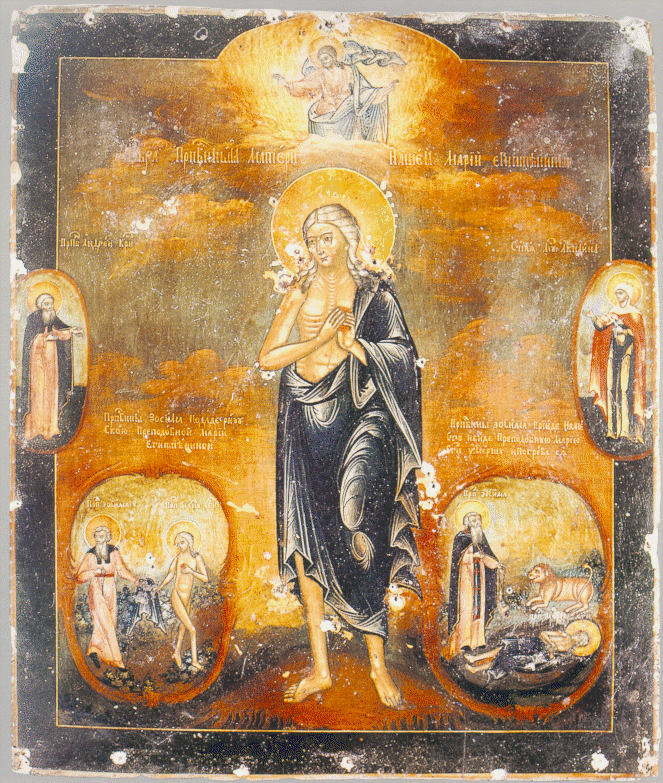
The lasting popularity of ascetic saints’ Lives can be seen in this eighteen-century Russian icon of Mary of Egypt. Mary’s body bears the marks of her extreme spiritual practices.
Image Attribution
“Mary of Egypt.” Anonymous icon. 18th century. Russian. RIISA Orthodox Church Museum of Finland, Kuopio. Photo Wikimedia, public domain.
Women Who Went Before is written, produced, and edited by Rebekah Haigh and Emily Chesley. The music is composed and produced by Moses Sun.
Sponsored by the Center for Culture, Society, and Religion, the Program in Judaic Studies, and the Stanley J. Seeger Center for Hellenic Studies at Princeton University
Views expressed on the podcast are solely those of the individuals, and do not represent Princeton University.